Approved, live, and scaling on Google in 60 days — or you stop paying until it is.
Even if Merchant Center already burned you once. Especially then. You get the exact system I scale with — plus me on your P&L every week. Not an agency reading you a dashboard.
Meta CPMs ate your margin, so you looked at Google. Then you heard the stories.
"Misrepresentation." Suspended at 9:04. Appeal denied by a robot at 9:07. No human, no reason, no channel. Years of work, gone in one automated email.
Or you're already on Google and it looks like this: a feed full of disapprovals you don't understand. An agency charging €2,500/month that sends a deck, quotes you a ROAS number your bank account has never met, and can't tell you which product is actually profitable after landed cost and refunds.
And the products. You test on vibes. €300 here, €500 there, because a TikTok looked viral. The loser runs for six weeks because nobody had a rule for killing it.
That's not a strategy. That's a slot machine with worse hours.
It's not you. You're doing a machine's job by hand. Feed compliance, product vetting, bid math, kill decisions — these are rule-based, evidence-based jobs. Humans do them late, emotionally, or not at all.
First, understand why Google is the channel worth owning: on Meta you have to create demand with creative that dies weekly. On Google, buyers are already typing exactly what they want to buy, card in hand. You don't need to go viral. You need to show up compliant, correctly priced, with a product that survives real math.
Google stores die three ways. The Engine deletes all three:
Every product, image, claim and identity field passes a 17-point pre-Google audit before Google ever sees it — a checklist built from a real suspension I autopsied, rebuilt from, and got approved after. The #1 killer in this business, handled before it happens.
~100 product concepts per research cycle crossed against real search demand, real supplier costs, real Shopping prices — and stress-tested economics. Most die in the machine. Only survivors touch your store and your budget.
Every campaign launches with automated stop-rules attached from day one: spend-without-conversion pauses, per-product cost tripwires, a hard daily cap enforced in code. Losers die in days. Not after three months of "let it optimize."
That's GDOS — my proprietary AI operating system for Google stores — plus me, an operator doing €4M/month, on your P&L every week. You can't buy the software. You can't hire me hourly. This engagement is the only door.
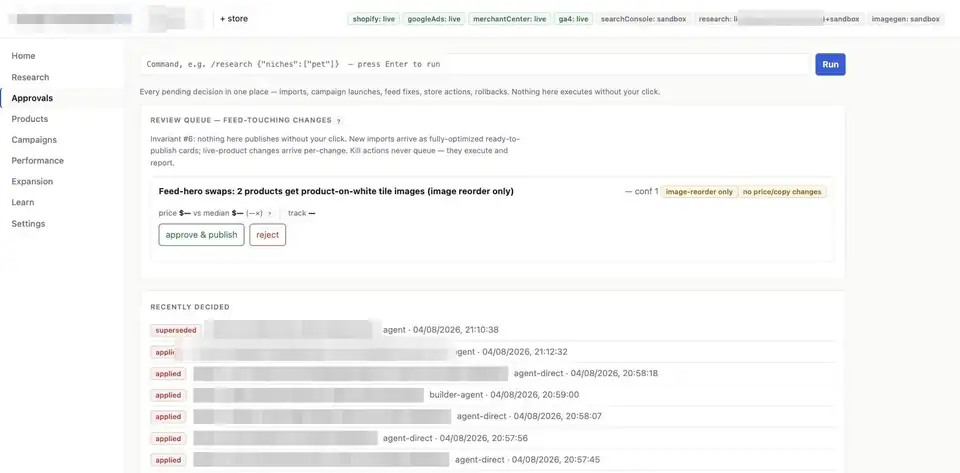
This is your dashboard. Every action that touches money queues here with its evidence and waits for your click. Approve from your phone in minutes a day. Everything else — the research, the feed, the triage — already happened while you ran your business.
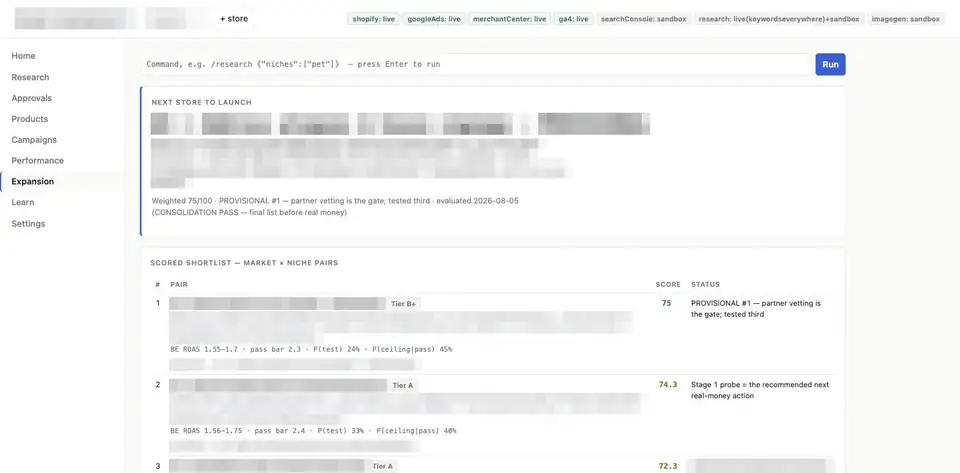
Markets are scored on 11 weighted criteria — chargeback exposure, undercut risk, real margins on verified supplier costs — before money moves. The kill list shows you every niche it refused, and why.
Every product candidate must survive demand data, price benchmarks, supplier verification and stress-tested economics. One recorded cycle: 100 evaluated, 45+ rejected with the exact numbers that killed them.
Titles, categories, images, claims: every field enters Google-clean. The live engine store scaled 5 → 51 products holding zero disapprovals. Your Merchant Center stops being a time bomb.
Auto-stop rules attach the day a campaign goes live. The slow bleed — the €2,000 nobody noticed leaving — is structurally impossible.
A daily pass triages tracking → feed → clicks → conversions → economics and surfaces what needs you. A weekly review issues per-product kill/scale verdicts with the evidence attached.
Reporting is contribution: orders minus landed cost, fees, refunds, acquisition. Store truth next to platform numbers, never conflated. You always know what's real.


Not as a SaaS, not as a license, not at any price. It operates client stores inside my engagements only — which is exactly why there are five slots and not five hundred.
My stores currently run at €4,000,000/month. I've operated ~20 stores across Google and Meta, and sold multiple of them — high-six-figure exits, completed. Store-level dashboards, not platform screenshots — shown on the call, verified before you pay.
Google suspended one of my machine-built stores for "misrepresentation" — the same email that kills everyone else. I didn't spam appeals. I autopsied it: full differential audit, root cause traced to identity data from account signup. Then I rebuilt clean under a new 17-point methodology. Result: approved, scaled 5 → 51 products, 20 disapprovals root-caused down to zero, campaigns live under kill rules.
Everyone selling Google services claims compliance expertise. Mine has a corpse and a rebuild behind it. That's why I can guarantee the approval — nobody else in this market dares.
My consulting rate is €1,000/hour — sold at that number, delivered at that number, testimonial available on request. The Engine includes 26 of those hours. Do that math against the price.
If your store isn't Merchant-Center-approved with live campaigns running under kill rules within 60 days of us getting access — billing pauses. We keep working, free, until you're live. That simple.
It is. On purpose. Here's what the market charges for less: a decent in-house media buyer is €30–60k for the same six months — no software, no research system, no compliance methodology, no guarantee. A "Google agency" runs €15k+ per half-year for a monthly deck and a ROAS number your bank never meets. A dead niche discovered live plus one suspension can burn €50k in a quarter.
You're buying the operator, the machine, and a guarantee — for less than the cost of guessing. And if €50k genuinely stings at your stage, you're not the buyer yet. That's fine. Come back bigger.
Minutes a day plus one hour a week. Your job is approvals — from your phone, with the evidence attached to every request — and the weekly session with me. The machine does the research, the feed work, the triage, the monitoring. The only way you slow it down is by not clicking.
Maybe. That's the honest answer, and the Engine is built on it: the first deliverable is the verdict. Your niche and catalog go through the same 11-criterion evaluation as everything else, and if the math says your niche can't win on Google, you hear it in week one — not in month five after €20k of spend. A kill verdict that saves your budget is the service working, and it's also why this starts with a DM and not a checkout page: I don't take stores the machine can't help.
Dead for people who run it on vibes — and their graveyard is your moat. Google Shopping is a compliance-and-price auction, not a creativity contest. Most of your competition is one policy email from disappearing, tests products on TikTok feelings, and never kills a loser. The Engine's edge is structural: gates that refuse fights you can't win (Amazon-undercut screens, margin floors, dispute-risk ceilings) and discipline that compounds while they churn. Saturation kills the sloppy. It subsidizes the compliant.
You can. I did. It took me ~20 stores, one suspension autopsy, multiple exits, and building the software — and I still run every new store through the machine instead of trusting my gut. Doing it yourself doesn't cost €0; it costs your ad budget as tuition and a year of your calendar. The question isn't whether you could learn it. It's whether learning it live is the best use of €50k and twelve months.
No countdown timer. The five is just true — every client gets weekly time with me and a machine-operated store, and I'd rather cap it than water it down. Meanwhile: every week your feed stays broken, Google hands the orders to someone whose feed isn't.